← Back to Blog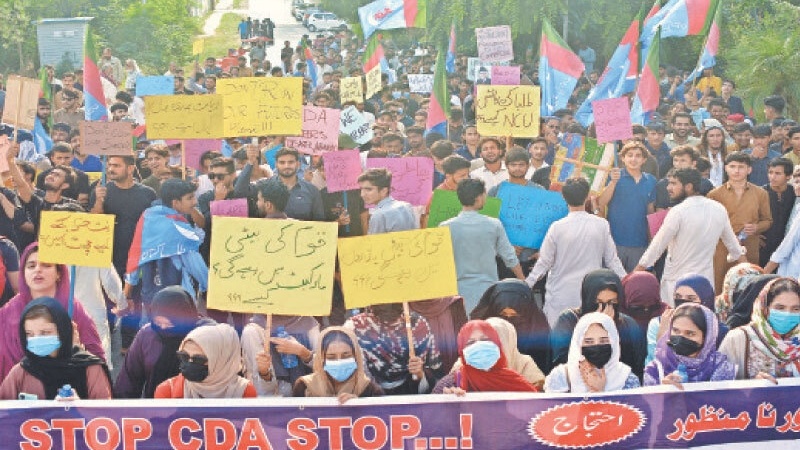
Hostels Campaign
Daniyal Abdullah·
Islamabad's CDA has evicted student hostels for a year, leaving students homeless and fighting in court. The article urges policymakers to reform rent laws and adopt UK-style HMO licensing.
When the City Evicts Its Students: The Fight for Student Housing in Islamabad
About a year ago, and largely unnoticed, the bureaucrats who staff the Capital Development Authority (CDA) declared student hostels located in residential areas illegal. Since then, students across Islamabad have been pushed out of their homes — sometimes through police crackdowns carried out in the middle of the night. Last week the drive reached its final refuge, and my friends and I now find ourselves among those left on the streets, fighting for the roof over our heads when we should be sitting our exams.
A Year-Long Eviction Drive
Following the CDA's decision, student hostels across Islamabad have been systematically evicted. For a time, Sector E-11 remained the last place where they could survive, owing to a legal ambiguity over whether the CDA's by-laws applied there.
That ambiguity no longer offers shelter. Last week the CDA launched an operation against student hostels in E-11, and we were among those affected. We were literally thrown out onto the streets, forced to fight a difficult legal battle against the city authorities simply to keep a place to live.
A Silence Hard to Understand
Because student housing strikes a chord with most humane souls, almost everyone has noticed the issue over the past few days — including two of the country's leading dailies. The notable exception has been the PTI leadership.
Their complicity, or at least their silence, is particularly hard to understand. University students represent a demographic — young, urban and college-educated — that proved crucial to the PTI's success in the 2018 Elections.
The party's propagandists still lace their speeches with slogans like "education emergency" and "knowledge economy". Yet on the simple, practical question of whether students have a right to live in residential areas, their lips have remained sealed. As students, we feel the PTI has abandoned us after using us as electoral fodder.
The Scale of the Problem
In declaring hostels "non-residential", urban authorities appear to have overlooked a basic fact. According to the Higher Education Commission, around 1,600,000 students are now enrolled in higher education institutions.
Universities do not — and perhaps cannot — provide official hostels for all 16 lakh of these students. As a result, most live as co-tenants in the residential sectors of Pakistan's metropolitan centres.
This is why the eviction drive has sent a shockwave across the country. Students are realising that if a drive which has continued in Islamabad for almost a year goes unchecked, municipal authorities in other cities could follow suit. In that case, we could all be in danger.
What the Developed World Gets Right
The short shrift given to student tenancy by Pakistan's urban authorities is deeply unfortunate. Elsewhere, societies treat students as a valuable addition to their social fabric. The administration of host cities extends every possible assistance to help student newcomers settle into their new environment, and these nations maintain adequate legal and market provisions to encourage part-time employment so students can support themselves.
Why Our Rent Laws Don't Fit
Our present rent laws carry substantial registration costs and are designed for families. Families have a clear structure of legal responsibility and rent entire houses for extended periods.
Student tenancy works differently:
- It takes dozens of students, pooling their means, to rent a single bungalow.
- Every few months a few students leave and fresh ones arrive.
- The arrangement is fluid and flowing — exactly what current law is not built to register.
A Model Worth Borrowing
The law in the United Kingdom (the Housing Act 2004 and 1985, and the rules made thereunder) offers a solution: the HMO (House in Multiple Occupation) licence. An HMO licence gives legal cover to student tenants who share the common facilities of a house while being unrelated to one another. To encourage the arrangement, the UK even exempts such licence-holders from council tax.
Our Future Hangs in the Balance
The government's eviction drive has left students with no option but to knock at the door of the courts. Our future in Pakistan's urban centres now hangs in a precarious balance.
We sincerely hope that policymakers at the highest level — those who claim to hold a vision for a "knowledge economy" — will look into the question of student tenancy and adopt a more pro-student policy.